Category Archives: 32 inch Cassegrain Project

Planets of the Month: Summer 2019

by Erich Karkoschka

Planets for Summer 2019 (June – September)

planet-of-the-month-mercury Mercury is visible all June until July 3 in the evening to the WNW just after sunset. In mid-June, it is the most obvious object in the western sky. August 3 -24 it is visible during dawn in the east.
planet-of-the-month-venus Venus is a difficult dawn object until July 18. It will reappear September 18 low at dusk.
planet-of-the-month-moon The Moon is New on June 3, July 2, July 31, August 30, and September 28. First Quarter Moon is June 10, July 9, August 7, September 5. Full Moon is June 17, July 16, August 15, and September 13. There is a partial Lunar Eclipse on July 16, visible in South America and further east.
planet-of-the-month-mars Mars is above Mercury in early June. On June 18, Mercury passes close to Mars. Then, Mars slowly gets lower during dusk until it disappears in the glow of the Sun at the end of June for the rest of the summer.
planet-of-the-month-jupiter Jupiter comes in opposition to the Sun on June 10 and is a great evening object all summer. It is moving toward Antares.
 planet-of-the-month-saturn  Saturn is just 30 degrees east of Jupiter. It is in opposition July 9 and will be a great evening object most of the summer as well. The brightest parts of the Milky Way are between Jupiter and Saturn in the night sky.
 planet-of-the-month-neptune  The distant, faint planets come in opposition September 8 (Neptune) and October 28 (Uranus).
 There are two eclipses in July. A Total Solar Eclipse July 2, visible in South America, and a Partial Lunar Eclipse on July 16, visible in South America and further east.

Planets of the Month: April 2019

by Erich Karkoschka

planet-of-the-month-mars Mars is still an evening object until 10 pm. It moves from the Golden Gate, between Aldebaran and the Pleiades, all the way through Taurus.
Jupiter transits at dawn.
Venus is further east and does not rise until 5 am during dawn.
Saturn is 26 degrees east of Jupiter, the closest since 2001.
Mercury races with Venus. The first half of April, it is slower than Venus, so Venus catches up to 5 degrees distance. Then is faster and gets slowly further away from Venus until it disappears after the 28th.
The minor Planet (2) Pallas is 8th Magnitude and high up in Bootes.

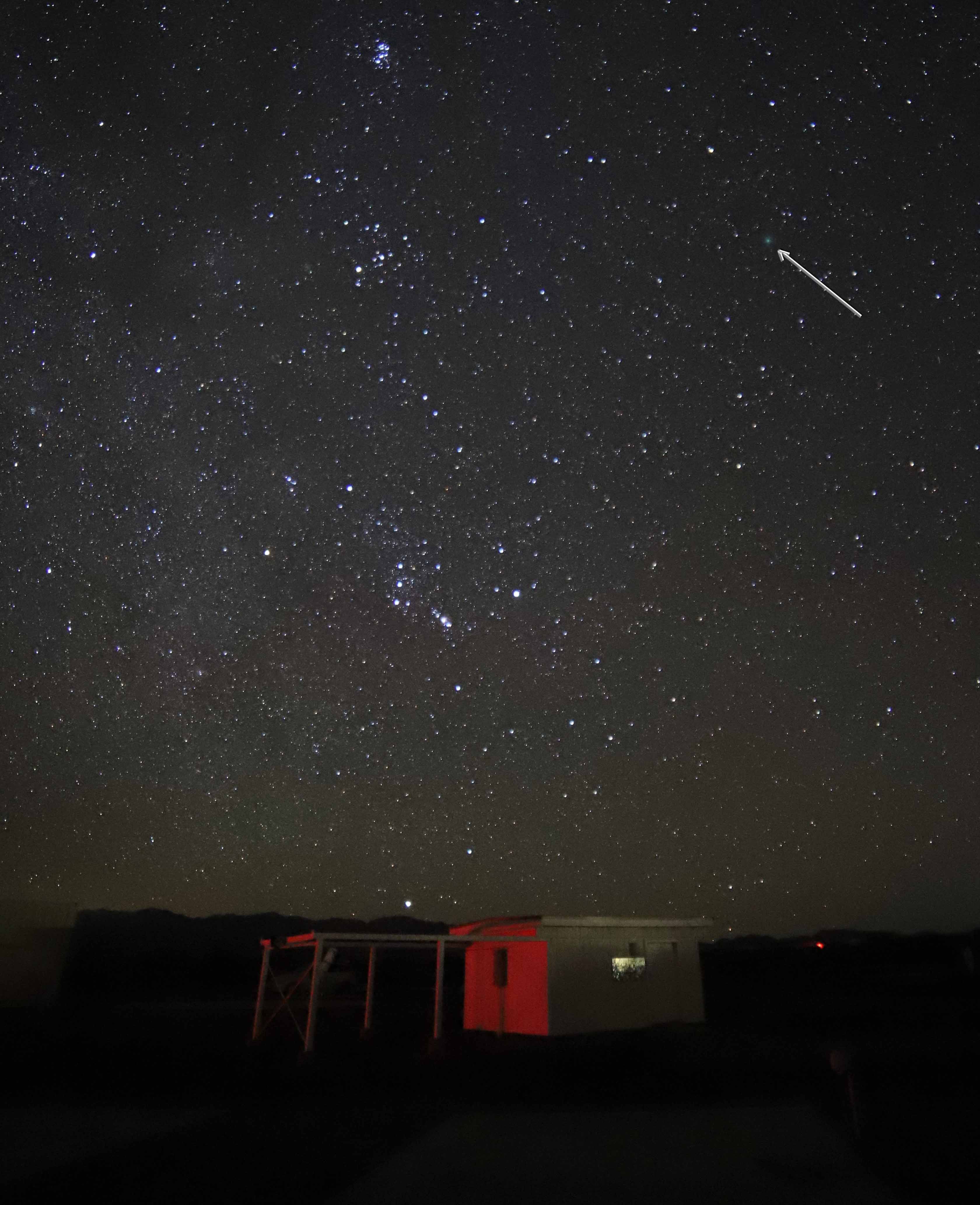
Comet 46P Wirtanen from CAC

We have a naked eye (from a dark site) comet visible (arrow). It is Comet 46P Wirtanen. Ed Foley, one of our TAAA members, took this picture from our Chiricahua Astronomy Complex dark-sky site during last weekend’s events (Saturday December 8, 2018). You can see one of our observatories as well. Those present observed it through several telescopes. It was also observed at last Saturday’s Ironwood Picnic Star Party and will be observed at this coming weekend (December 15) Agua Caliente Park star party.

46 P Wirtanen over Wally Rogers Observatory 2 (compressed)