The messages from the TAAAA president have appeared in various forms over the years. They have appeared in the Desert Skies publications, in the TAAA Monthly Bulletin, and now appear in the revamped monthly Desert Skies TAAA Bulletin. For a period of TAAA history, the Notes were send as a stand alone message to members from 2018 to 2021. Those communications with summaries of the work of the TAAA board and important monthly accomplishments by the organization are listed below.
Just one day after the Earth passed its perihelion, the closest point to the Sun in its orbit, the American Astronomical Society was having its annual meeting online, the United States Congress was validating the results of the 2020 national election, and Wendee and I were settling in for a civics lesson about the way the United States Government works. The day did not turn out as we expected.
Shortly before noon, as we watched our television set a news ticker appeared. It announced that two buildings in the Library of Congress (LC), the James Madison, and quickly afterwards the Adams and Jefferson buildings, were being evacuated. That news sent an ugly chill through me. The LC is one of the finest libraries in the entire world. It contains more than 170 million books, of which more than thirty are books I wrote entirely or those for which I penned the foreword. It also includes all of the more than two hundred “Star Trails” columns I wrote for Sky and Telescope magazine between 1988 and 2008, and dozens more I wrote for other magazines and journals. Only the British library, with over 200 million books, is larger.
This evacuation was quite personal for me. A few minutes later, when the entire Capitol complex was stormed, it was personal for all of us. All of us had reactions to this, but in addition to the feelings I had, I felt a major conern for the library.
How many books does it take to make a library? When I was a child in 1963, a teacher told me his answer: “two books.” To me, a library– any library– is every bit as priceless as a dark sky. The wisdom of the ages is contained in each library- from the LC to a child’s collection. I have never gone into a library without feeling better when I exited. The idea that this magnificent collection was threatened that day was terrifying.
I have read many books over my lifetime, from The Cat in the Hat to my boxed set of Lord of the the Rings. One small treasure, Jene Lyon’s Golden book Our Sun and the Worlds Around It, opened a door to a lifetime of stargazing. (That gem, by the way, also lives in the LC). What is more, I have never encountered a really bad book. When an author places her or his thoughts on paper in a book, that book immortalizes those thoughts.
I hope that Capitol Hill and the Library of Congress are never threatened again. They belong to we the people, and stand beautifully in Washington, D.C. to govern us, teach us, and encourage us to follow our dreams and reach for the stars.
Mars is the only evening planet. During dusk it becomes visible in the west 45 degrees high and sets just before midnight. It passes the M35 cluster on the 26th within half a degree.
Our two giant gas planets continue to separate from their close passage last December, from 12 degrees to 15 degrees distance during the month. They rise just before the morning twilight in the southeast and get up to 20 degrees high once dawn gets bright.
On the morning of the 2nd, Jupiter will appear to have an extra satellite because 44 Capricorni sneaks exactly into the line of Galilean satellites with just the right magnitude.
No other planet will be easily visible during April. Specialists may find Uranus after dusk during the first week and Mercury and Venus during dusk at the end of the month. Both planets will be only separated by 1 degree on the 25th. By the 30th, Mercury will appear 5 degrees above Venus and getting to be easier to spot. Both planets will stay together will visible for most of May.
The Full Moon on the evening of the 26th will be during perigee which makes for a large bright Full Moon. Last Quarter Moon is April 4 New Moon is April 11, and First Quarter April 19.
Mars is the only evening planet. During dusk, it becomes visible in the southwest 70 degrees high and sets around midnight. It passes the Pleiades on the 4th within 3 degrees, which is closer than during the next 17 years.
The morning sky has three planets close to each other, the same planets that were close together in the evening sky at the beginning of the year: Mercury, Jupiter, and Saturn.
Saturn rises first, before twilight starts. Mercury and Jupiter rise half an hour later during the first week. They are close together, closest in the morning of the 5th (only .4 degrees). Jupiter is the brighter one of the close pair. Mercury races away from Jupiter and will get lost too close to the Sun on the 23rd. Jupiter and Saturn separate only slowly, from 8 degrees at the beginning of March to 11 degrees at the end.
Two additional planets can be seen in the evening sky with good eyes. Both are 6th magnitude this month. Uranus is about 30 degrees below Mars (~3 clenched fists width at arms length). Minor planet Vesta is in Leo, transiting 75 degrees high around midnight. Vesta’s motion is much faster than Uranus’, so it is easy to see its motion from night to night. Only once every three years or so does a minor planet become naked eye for several weeks.
The Moon will be close to the trio of planets in the morning sky on the 9th and then only three degrees from Mars on the 19th. The thin lunar crescent will be first visible in the evening sky on the 14th, setting before 8 pm.
Mars is the only naked eye evening planet. It transits at sunset more than 72 degrees high and sets past midnight. It moves through Aries and almost reaches the Pleiades by the end of the month.
On the 17th, three planets appear simultaneously in the morning sky. Jupiter is the brightest, but also lowest. Mercury is 4 degrees above Jupiter and Saturn is 4 degrees to the right of Mercury. For the next week, the three planets become easier to see while
maintaining their relative positions. Then, Mercury will be approaching Jupiter faster and faster and pass it very close on March 5th. By February 28, Mercury will be at its best while Jupiter and Saturn continue to become more obvious in March. During February, they all rise during dawn and remain low. The best
time is shortly after 6 am. Remember, those three planets were even closer together in the evening sky around January 10th.
Uranus is still visible in Aries to the lower right of Mars in the evening sky.
Vesta, minor planet number 4, is getting up to 6th magnitude in Leo and might be seen naked eye in March.
On the evening of February 12th, the 1 percent illuminated moon can be found low at dusk just before 7 pm. Last Quarter Moon is on the 4th, New Moon on the 11th, First Quarter Moon on the 19th, and Full Moon on February 27th.
Jupiter and Saturn will get as close as .1 (1/10 of a degree) from each other on December 21st (Winter Solstice) — they are actually separated by distance as Jupiter is 551 million miles from Earth and Saturn is abut twice as far at just over 1 Billion miles from Earth . That will be close enough to challenge being able to separate both with just your eyes. If you get a chance, observe them with your eyes, a pair of binoculars, or a telescope (great opportunity to compare both planets at high power in the same field of view). For comparison, the width of your clenched fist held at arms length is about 10 degrees. On the 21st, they set pretty shortly after sunset, so go out about 1/2 hour after sunset to view them (they will set around 7 pm). The last time they got this close together and were both observable was 1226 (794 years ago). The next conjunction that will be this close will be in 2080. The pair starts December about 2 degrees apart. The distance decreases by about .1 degree every day, so observe them every evening and watch them get closer to each other. Look for a small crescent Moon near the pair on the 16th (5 degrees below) & the 17th (10 degrees to the left).
Venus rises after 5 am and is still conspicuous during dawn. Venus will be only be 1/6 of a degree from a second magnitude star (Acrab) on the morning of the 18th. This is too close to see next to bright Venus with the naked eyes, but a splendid view in binoculars.
Mars fades quickly this month, but is still the brightest object aside from Jupiter and Sirius after it rises late evening. Its diameter of 14 arc-seconds is still larger than its opposition diameter during less favorable oppositions, such as in 2027.
Uranus is 20 degrees to the upper left of Mars at the beginning of December. It can be easily seen in binoculars but requires some practice to find it. By the end of the year, the separation to Mars is only 10 degrees.
Neptune is well to the lower right of Mars, best observable right after dusk.
On the morning of December 12th, the thin lunar crescent will be only 3 degrees from Venus, most spectacular between 5:30 and 6 am. Very experienced observers may try to find them in the afternoon when the moon will occult Venus at around 2:20 pm. They will be only about 15 degrees high. The moon will definitely not be visible naked eye because it is too slim, but the view in a telescope would be good with the disappearance of Venus taking half a minute.
On the 14th, part of Chile and Argentina will experience a total solar eclipse. Some of us had plans to observe it, but had to cancel because of travel restrictions. Instead, we can watch the Geminid meteor show the evening before without moonlight and a peak predicted to occur during that evening, the 13th. Best viewing though is the early morning hours of December 14th.
Below is the News Release and Grand Canyon Star Party Facebook Event with schedule (the schedule is also listed below). The event will be through Facebook Live starting Saturday June 13 through Saturday June 20, 2020. Each night a talk will be given at 6 pm (Arizona/PDT) and a virtual star party at 7 pm (Arizona/PDT).
Grand Canyon’s 2020 Star Party will be Hosted Virtually
[A night sky with red lighting in the forefront highlights telescopes looking at the sky. The words “Welcome to the Virtual Grand Canyon Star Party 2020!” are superimposed over the image.] The 30th annual Grand Canyon Star Party will be held virtually June 13-20, 2020. While the on- site event at Grand Canyon National Park has been cancelled on both rims due to concerns over
COVID-19 this year, the park hopes to bring the wonders of the night sky into the virtual realm
through a series of video premieres on Grand Canyon’s official Facebook account.
Go to Facebook to participate in event. Or go to Facebook and set up a personal reminder.
JUN 13 AT 6 PM – JUN 20 AT 8:30 PM
Online Event
Public · Hosted by
Grand Canyon National Park
Virtual Grand Canyon Star Party 2020
Welcome to the Virtual Grand Canyon Star Party 2020!
Grand Canyon National Park and the Grand Canyon Conservancy invite you to the Virtual Grand Canyon Star Party 2020, June 13-20…
Schedule Saturday, June 13, 2020 6:00 PM – 7:00 PM
Dark Skies in Isolation: Why Protecting the Night Sky is More Important Than Ever by Dr. John Barentine 7:00 PM – 8:30 PM
Virtual Grand Canyon Star Party: Session 1 by the Tucson Amateur Astronomy
Association
Sunday, June 14, 2020 6:00 PM – 7:00 PM
Lions, Vultures, and a Scorpion, Oh My! A Summer Jaunt through Arabian Skies by Dr.Danielle Adams 7:00PM – 8:30PM
Virtual Grand Canyon Star Party: Session 2 by Focus Astronomy
Monday, June 15, 2020 6:00 PM – 7:00 PM
A Tour Through the Universe by Dean Regas 7:00 PM – 8:30 PM
Virtual Grand Canyon Star Party: Session 3 by the Tucson Amateur Astronomy
Association
Tuesday, June 16, 2020 6:00 PM – 7:00 PM
Infant Galaxies to Alien Atmospheres: NASA’s James Webb Space Telescope by Dr. Amber Straughn 7:00 PM – 8:30 PM
Virtual Grand Canyon Star Party: Session 4 by Focus Astronomy
Wednesday, June 17, 2020 6:00 PM – 7:00 PM
The Art of Photographing Dark Skies by Shreenivasan Manievannan 7:00 PM – 8:30 PM
Virtual Grand Canyon Star Party: Session 5 by the Tucson Amateur Astronomy
Association
Thursday, June 18, 2020 6:00 PM – 7:00 PM
One Giant Leap: Apollo Astronaut Training in the Grand Canyon by Kevin Schindler 7:00 PM – 8:30 PM
Virtual Grand Canyon Star Party: Session 6 by Focus Astronomy
Friday, June 19, 2020 6:00 PM – 7:00 PM
Astrophotography for Beginners by Bettymaya Foott 7:00 PM – 8:30 PM
Virtual Grand Canyon Star Party: Session 7 by the Tucson Amateur Astronomy Association
Saturday, June 20, 2020 6:00 PM – 7:00 PM
Planetary Defense: Surveying the Sky for Killer Asteroids by Professor Vishnu
Reddy 7:00 PM – 8:30 PM
Virtual Grand Canyon Star Party: Session 8 by Focus Astronomy
Definitely Also SEE Additional Information on NPS Web Page
Including info on 2021 GCSP:
Mercury is easy to see in the northwest in the evening below Castor and Polux at the beginning of June between 8 and 9 pm. It can be spotted until June 15.
Venus gets so close to the sun that it occults part of the solar corona on the 3rd, the only time until the 22nd Century. Starting on the 9th, it will be the morning “star”, when it will be only 1% illuminated. A beautiful, large, and thin crescent, visible even in small binoculars. Its illumination increases to 18% by the end of the month when it reaches almost maximum magnitude. A special event will be June 19 when the extremely thin crescent Moon will rise 2 degrees below Venus at 4 am. Venus will be obvious while the Moon will be pale as dawn brightens.
A Moon/Venus conjunction will take place the morning of June 19 before dawn. The Moon is full June 5, Last Quarter June 13, New June 21, and First Quarter June 28.
Mars rises later but climbs up higher then Jupiter and Saturn by dawn. Mars is brightening toward its October close opposition. Only Venus and Jupiter are brighter than Mars.
Jupiter rises around 10 pm, by 9 pm later in June. Jupiter and Saturn are only 5 degrees apart. Jupiter is three magnitudes brighter than Saturn.
Saturn rises around 10 pm, by 9 pm later in June. Jupiter and Saturn are only 5 degrees apart. Saturn is three magnitudes dimmer than Jupiter.
Uranus rises two hours later than Neptune and is still low when dawn starts.
Neptune is 1.6 degrees to the northwest of Mars on the 13th.
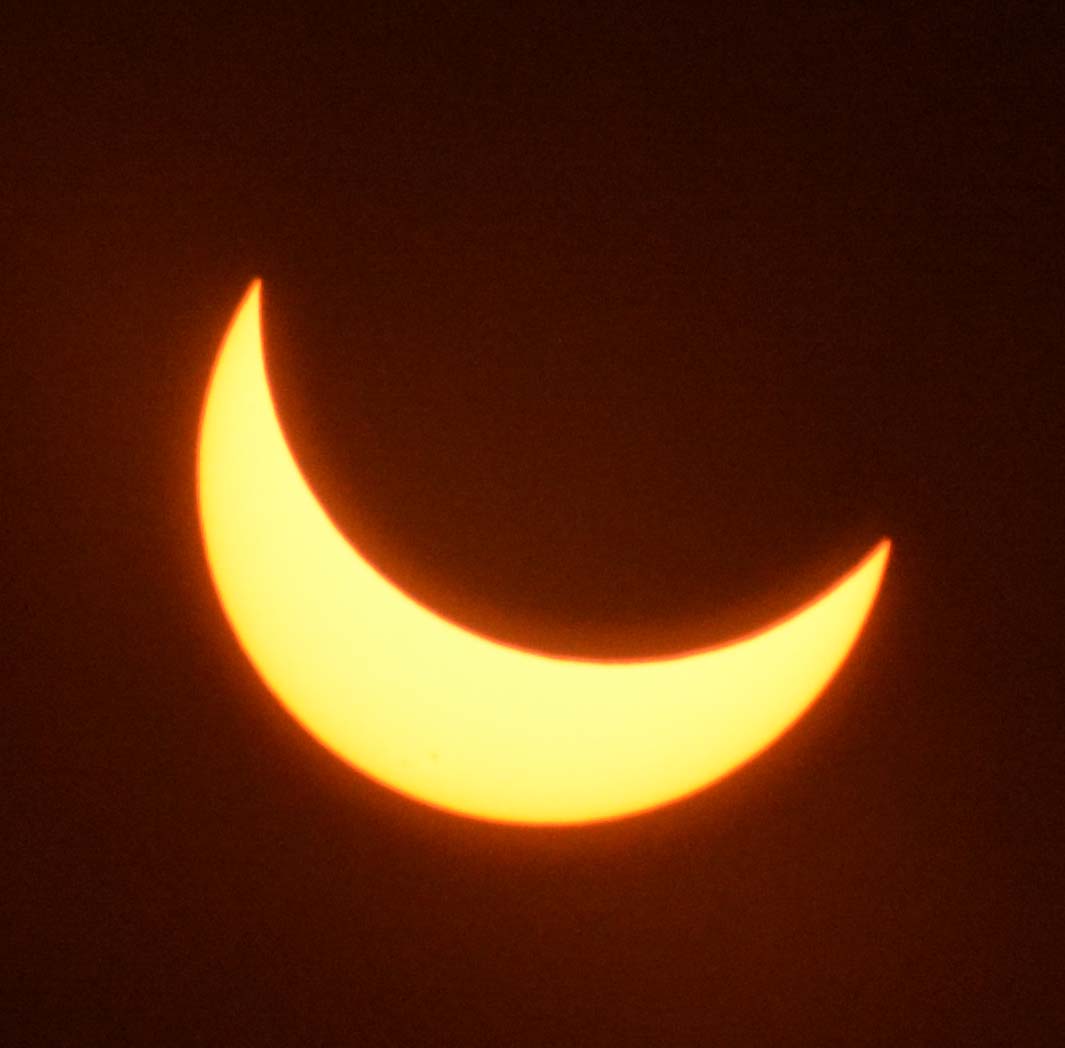
Asia and Africa will experience a solar eclipse on June 21st. It is an annular eclipse, so not quite total. An annular is when the Moon doesn’t quite cover the Sun and there is a small ring of the Sun around the Moon.
Often referred to as one of the most brilliant and beautiful winter open clusters, M37–my saltshaker cluster–is the brightest of the Auriga clusters (M36, M37,M38) NASA Image
A few virtual events happening this week (April 19 – 26, 2020) in support of International Dark Sky Week on Facebook Live & You Tube. The Facebook pages below are public pages, so you do not need to have a Facebook account to view them. If you miss any live events, they will probably be available under Facebook Video’s.
Tuesday April 21. 11:30 am Arizona Time (GMT-7 or Pacific Timezone) on the Grand Canyon Conservancy Association (GRCA) Facebook Page (https://www.facebook.com/grandcanyonconservancy/). Ranger Rader Lane will discuss GRCAs journey to become an International Dark Sky Park.
Tuesday April 21. 8:00 pm Arizona Time (GMT-7 or Pacific Timezone) on our TAAA Facebook Page, we will be doing a Virtual Star Party, observing about 12 objects for an hour and half. TAAA Facebook Page: https://www.facebook.com/TucsonAstronomy/. The live event may be located under the Videos section.
Thursday April 23. 12 pm (Noon) Arizona Time on the GRCA Facebook Page. Dean Regas will do a Live Virtual Tour of the Universe.If you don’t immediately see the live video when you go to the Facebook page at the appointed time, look under the Live or Video section of the page.
All Week. Log into the International Dark Sky Association International Dark Sky Week page for a schedule of presentations all week long. Many are specific for children and would be good for kids or grandkids. The link to the webpage is: idsw.darksky.org. Once there select schedule.
Mercury is easily visible in the first half of the month during dust in the west. It disappears after the 18th.
Venus is 40 degrees high at sunset and even 44 degrees by the end of the month. This is close to the maximum possible. It sets after 9 pm. The Moon will visit Venus on the 27th, a beautiful sight.
MAIN EVENT. Occultation of Mars by the Moon on the morning of February 18, well visible from Tucson before dawn in the southeast. It starts about an hour after Mars rises and lasts for another hour. Mars disappears behind the bright side of the Moon at 4:38 am and will reappear at 5:40 am along the dark side. The disappearance will be visible in binoculars as Mars slowly becomes invisible at the bright limb of the Moon. The reappearance will also take about 20 seconds. Since it occurs at the dark limb, it can be observed with the naked eye.
Uranus is 60 degrees high after dusk, visible in binoculars or a telescope.
Morning Sky. Mars rises at 4 am. Jupiter follows at 5 am, and Saturn at 6 am. These three planets will get closer to each other as the month progresses.